
Tech CEOs Acting Badly
What AI’s executives keep saying out loud — and the calmer truth about your job.

Last Sunday, the former chief executive of Google stood in front of the University of Arizona’s graduating class and tried to tell them the future would be wonderful. They booed him. Not once — repeatedly. When Eric Schmidt drew a parallel between artificial intelligence and the arrival of the personal computer, the stadium turned on him. He paused, and said something more honest than most of his peers have managed in three years of breathless AI promotion:
“I know what many of you are feeling about that. I can hear you… there is a fear in your generation that the future has already been written, that the machines are coming, that the jobs are evaporating… and I understand that fear.”[1]
He does not, in fact, appear to understand it — because he kept going, telling graduates the transformation ahead would be, in his words, “larger, faster and more consequential than what came before.” That promise — bigger, faster, more disruptive than anything that came before — was exactly what the graduates did not want to hear, and the boos rose to meet it. The scene opened The Wall Street Journal’s May 20, 2026 report, “The American Rebellion Against AI Is Gaining Steam.”[2] Here is the thing the executives keep missing: these young people are not afraid because they don’t understand the technology. They are afraid because they understand it perfectly well, and they have been listening to what the people who own it actually say about them.
The quiet part, said out loud
If you want to know why a generation is booing commencement speakers, read the transcripts of what business leaders say when they think only investors are listening. Two days after the Arizona speech, Standard Chartered’s chief executive Bill Winters stood at a press conference in Hong Kong and explained the bank’s plan to cut roughly 7,800 support roles by 2030 to fund its AI push. He did not call it cost-cutting. He called it something worse:
“It’s not cost-cutting. It’s replacing in some cases lower-value human capital with the financial capital and the investment capital we’re putting in.”[3]
“Lower-value human capital.” Those are people — in HR, in risk, in compliance — with mortgages and kids and aging parents. Former Singapore president Halimah Yacob publicly rebuked Winters for the phrasing, and she was right to. It is the kind of language that tells you exactly how a person sees the humans on the other side of the spreadsheet.
And he is no outlier — just less guarded than most. Anthropic’s Dario Amodei spent 2025 warning that AI could “wipe out half of all entry-level white-collar jobs”[4] and push unemployment to 10–20%, framed — generously — as honesty: “We, as the producers of this technology, have a duty and an obligation to be honest about what is coming.” At a Florida commencement this month, real-estate executive Gloria Caulfield got the same booing treatment Schmidt did for declaring that “the rise of artificial intelligence is the next industrial revolution.”[5] And in the Journal’s reporting, an industry analyst cheerfully observed that “People hate AI. AI is less popular than [Immigration and Customs Enforcement]. AI is less popular than politicians,” while a data-center developer reportedly dismissed the communities fighting his projects as “cave people.”[6]
And it isn’t only the back office that gets written off in public. Mark Zuckerberg has spent the past year telling some of the best-paid workers in the country that they’re next. On a widely shared podcast appearance, he put it this way:
“Probably in 2025, we at Meta, as well as the other companies that are basically working on this, are going to have an AI that can effectively be a sort of midlevel engineer that you have at your company that can write code.”[7]
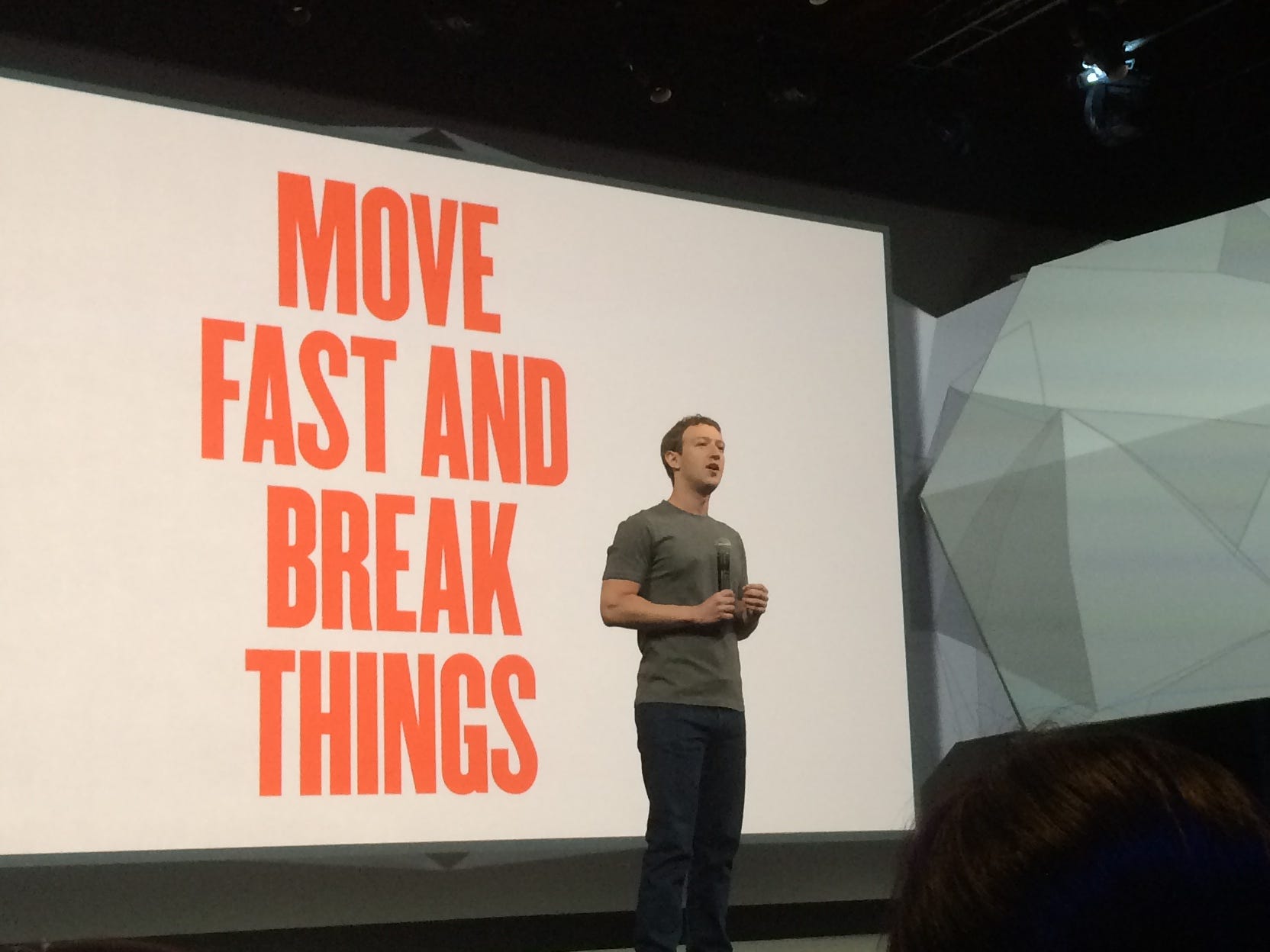
Source: Wikimedia
Tell a room full of six-figure engineers that a model will do their job by year’s end, then act surprised when the anxiety curdles into anger. That is the pattern: the people with the most to gain from AI keep narrating, out loud, exactly how little they believe they need everyone else.
OpenAI’s chief global affairs officer Chris Lehane has a tidy theory for why sentiment has collapsed: it’s the messaging. “If you’re going to constantly and consistently talk about AI from a fear perspective, you are going to drive fear,”[8] he told the Journal. But people aren’t afraid because critics are scaring them. They’re afraid because they can read a balance sheet and a headline at the same time, and they’ve noticed that the layoff press releases and the “abundant future” press releases come from the same building.
Let me put my own view on the record, because the polite version of this critique lets too many people off the hook: a chief executive who can stand in public and describe the people who built his company as “low-value” has already demonstrated the single most important disqualification for the job. Leadership is, at its core, the stewardship of other people’s livelihoods and dignity. A CEO who treats both as line items to be optimized away has forfeited the trust the role requires — and frankly should lose it. You cannot credibly ask employees to give a company their best years while telling shareholders, in the same breath, that those same employees are the cheap part of the equation.
There is a deeper point worth saying plainly. The notion that a chief executive answers to shareholders and to no one else is not a timeless law of capitalism — it is a specific and surprisingly recent doctrine, popularized by Milton Friedman in a 1970 essay arguing that the sole social responsibility of business is to increase its profits.[9] It is a creed that should have aged out long ago, and by the boardroom’s own account it largely has: in 2019, 181 of the most powerful chief executives in America, through the Business Roundtable, formally set aside shareholder primacy and pledged to serve all of their stakeholders.[10] A modern CEO owes a duty to shareholders, yes — but the duty does not end there. It runs to customers, to employees, and to the communities from which a company draws its workforce, its goodwill, and, increasingly, its electricity. A leader who can see only the shareholder hasn’t modernized; he has simply stopped reading past the first line of the job description.
Fear is a sign of intelligence
Fear is a sign of intelligence. Worrying about what AI will do to the workforce — and to your job in particular — is both rational and well-founded; the people who feel nothing about it are usually the ones who haven’t been paying attention. Andy Grove, Intel’s legendary chief executive, made an entire management philosophy out of that instinct: “Only the paranoid survive.” A measured dose of worry isn’t weakness — it’s the early-warning system that gets you moving before the wave hits.
To the class of 2026, and to everyone a decade or two into a career who feels the ground shifting: your fear is not irrational, and you are not a Luddite for feeling it. Agentic AI — systems that don’t just answer questions but carry out multi-step work — is genuinely good at exactly the tasks that used to be the first rung of the ladder. Drafting the memo. Reconciling the accounts. Writing the boilerplate code. Summarizing the deposition. Building the slide deck. Those entry-level jobs were never glamorous, but they were how you got paid to learn, and how you proved you belonged. When a model does them for a fraction of the cost, the ladder loses its bottom rungs, and that is a real, material problem that hand-waving about “new jobs we can’t imagine yet” does not solve for the 22-year-old who needs a job this year.
It is also true that the disruption is uneven and arriving fast. The same Wall Street Journal article reporting documents data-center fights from Maine to Arizona, rising electricity bills, four city-council members in Festus, Missouri ousted a week after approving a $6 billion data center, and a backlash that pollsters describe as nearly unprecedented in speed.[11] When change moves faster than people can adapt, anger is the rational response, not a public-relations failure to be managed. Anyone who tells you otherwise is selling something — usually compute.
Always and never are rarely true: not all of our jobs are going to be replaced by agentic AI
The catastrophe narrative is as lazy as the utopia one. “AI will replace everyone” and “AI will replace no one” are both wrong, and for the same reason: always and never are rarely true. Reality almost always lives in the messy middle, and the middle is where you can actually plan a life.
Start with the executives’ own behavior, because it betrays the gap between rhetoric and reality. If agentic AI were truly ready to replace people wholesale, companies would simply do it quietly and pocket the savings — not run six-month “transformation” programs, retain consultants, and stage press conferences. The grand replacement claims are partly a negotiating posture: a way to justify layoffs already planned, discipline labor, and keep investors funding the enormous capital bills. Fortune and others reported in 2026 that AI-driven layoffs frequently aren’t generating the promised returns — firms reporting strong AI ROI cut staff at roughly the same rate as those reporting weak or negative ROI, which means the cuts are often a story executives tell, not a productivity result they’ve measured.[12] Even Amodei has since softened his “bloodbath” framing toward augmentation rather than wholesale elimination.
You don’t have to take this on faith; the two biggest AI spenders just ran the experiment in public. In May 2026, Meta cut roughly 8,000 jobs — about ten percent of its staff — three weeks after posting a record quarter: $26.8 billion in profit on $56.31 billion in revenue. At an all-hands beforehand, Mark Zuckerberg told employees the obvious explanation was the wrong one. “Getting everyone internally to use AI tools and getting to do the work more efficiently is not the thing that’s driving layoffs,” he said. His own chief financial officer supplied the real reason: a “leaner operating model,” she told analysts, would help “offset the substantial investments we are making” — namely a 2026 capital-expenditure budget of $125 to $145 billion, nearly double the prior year, almost all of it bound for chips and data centers.[13] Translated: those workers weren’t replaced by AI. They were sold off to help pay for it.
Oracle ran the same play at greater scale, cutting around 30,000 roles in 2026 while guiding capital spending toward $50 billion — up from roughly $14 billion two years earlier. Analysts at TD Cowen estimated the cuts would free up $8 to $10 billion a year, conveniently close to the size of the new data-center bill.[14] In both cases the headline wrote itself as “AI replaces workers.” The cash flow tells a less futuristic story: profitable companies thinning their payrolls to bankroll the most expensive infrastructure bet in corporate history.
Then look at what these systems actually do. Agentic AI is powerful and brittle in the same breath. It is superb at well-specified, repetitive, text-and-data tasks and unreliable at exactly the things most jobs are secretly made of: judgment under ambiguity, accountability when something goes wrong, persuading a nervous client, reading a room, knowing which rule to break. A model can draft the compliance memo; it cannot sit across from a regulator and stake its reputation on it. It can generate the marketing campaign; it cannot be fired for the one that offends a city. The work that remains is less “do the task” and more “own the outcome,” and ownership is stubbornly human.
This is why the smarter version of Schmidt’s own advice is worth rescuing from the booing. Even he, between the tone-deaf lines, landed on something true: “The future is not yet finished. It is now your turn to shape it.” The mistake is hearing that as “adapt or die.” The better reading is that the outcome is still genuinely unwritten, and that far more of it than you’d expect comes down to what you personally choose to do with these tools — whether you learn to direct them or stand still and try to compete with them. The plumber, the nurse, the electrician, the teacher, the contractor, the therapist, the skilled-trades apprentice — these are not “lower-value human capital,” and no agent is going to rewire your house or hold your hand in the ER. Whole categories of work are not going anywhere, and many will become more valuable precisely because they are scarce and human.
And here is the part the doom narrative leaves out: there has never been a better moment to become the most productive person in your office. Didn’t go to an Ivy League school? That matters less than it ever has. Real fluency with these tools can set you apart from more credentialed colleagues faster than any résumé could — not by out-working everyone, but by out-producing them. The goal isn’t to race the machine; it’s to be the person in the room who gets the most out of it. That is how you make yourself indispensable.
None of that means coasting. It means the honest middle position: learn to use these tools fluently so you’re the one holding the controls; build the human skills models can’t fake; and refuse the false choice between blind optimism and despair. Disruption is real. Total replacement is a myth. Both things are true at once.
[1]Mirna Alsharif and Austin Mullen, “Former Google CEO Eric Schmidt booed during graduation speech about AI,” NBC News, May 17, 2026. https://www.nbcnews.com/tech/tech-news/former-google-ceo-booed-graduation-speech-ai-rcna345585
[2]“The American Rebellion Against AI Is Gaining Steam,” The Wall Street Journal, May 20, 2026 print edition (headlined “Americans’ AI Rebellion Grows, Fed by Energy Costs, Job Losses”). https://www.wsj.com/tech/ai
[3]“Standard Chartered CEO Winters Warns AI Will Replace Thousands of Bank Roles,” Bloomberg, May 19, 2026 — remarks at a Hong Kong press conference; the bank announced roughly 7,800 job cuts by 2030. https://www.bloomberg.com/news/articles/2026-05-19/stanchart-ceo-says-ai-to-replace-lower-value-human-capital
[4]Jim VandeHei and Mike Allen, “Behind the Curtain: A white-collar bloodbath,” Axios, May 28, 2025. https://www.axios.com/2025/05/28/ai-jobs-white-collar-unemployment-anthropic
[5]Gloria Caulfield, commencement address, University of Central Florida, May 2026, as reported by NBC News / TODAY.
[6]Dylan Patel (CEO, SemiAnalysis) and the unnamed data-center executive (“cave people”) both quoted in The Wall Street Journal, “The American Rebellion Against AI Is Gaining Steam,” May 20, 2026.
[7]Mark Zuckerberg, The Joe Rogan Experience, January 2025; reported in “‘AI Can Write The Code’: Zuckerberg Says Meta’s Midlevel Engineers May Soon Be Replaced,” Benzinga, January 2025. https://www.benzinga.com/startups/25/01/43196923/ai-can-write-the-code-zuckerberg-says-metas-midlevel-engineers-earning-six-figures-may-soon-be-replaced
[8]Chris Lehane, quoted in The Wall Street Journal, “The American Rebellion Against AI Is Gaining Steam,” May 20, 2026.
[9]Milton Friedman, “A Friedman Doctrine — The Social Responsibility of Business Is to Increase Its Profits,” The New York Times Magazine, September 13, 1970. The essay crystallized the shareholder-primacy doctrine that dominated corporate America for the next half-century.
[10]Business Roundtable, “Statement on the Purpose of a Corporation,” August 19, 2019 — signed by 181 chief executives, replacing shareholder primacy with a commitment to deliver value to customers, employees, suppliers, communities, and shareholders alike. https://www.businessroundtable.org/business-roundtable-redefines-the-purpose-of-a-corporation-to-promote-an-economy-that-serves-all-americans
[11]Backlash details — the Festus, Missouri council recall and data-center opposition from Maine to Arizona — from The Wall Street Journal, “The American Rebellion Against AI Is Gaining Steam,” May 20, 2026.
[12]“AI isn’t paying off in the way companies think,” Fortune, citing Gartner research, May 11, 2026. https://fortune.com/2026/05/11/ai-automation-layoffs-gartner-study-roi/
[13]Meta’s May 2026 layoffs and Q1 results: Hillary Remy, “Mark Zuckerberg sends stunning message to Meta employees,” TheStreet, May 15, 2026 (layoffs first reported by Reuters, March 14, 2026). Zuckerberg’s April 30, 2026 town-hall remark and CFO Susan Li’s earnings-call comment quoted therein; Q1 2026 revenue $56.31B, net income $26.8B; 2026 capex guidance $125–145B, up from $72.2B in 2025.
[14]Oracle’s 2026 workforce cuts (~30,000 roles) and capital-spending ramp: “Oracle cutting thousands in latest layoff round as company continues to ramp AI spending,” CNBC, March 31, 2026; FY26 capex guidance ~$50B versus $14.2B in FY24; TD Cowen estimate that the cuts free up roughly $8–10B in annual cash flow, as reported by Bloomberg and Yahoo Finance, March 2026.
Free subscribers: You’ll continue to receive selected articles, market commentary, and educational pieces at no cost.
Paid Substack: ($8/month or $80/year): Get access to subscriber-only posts and occasional featured funds and ETFs.
Founding Member All-Access Bundle: Substack+Website ($179/year): Unlock everything: all paid Substack content plus full access to InvestmentInsights.com, including everything from 90+ in-depth fund and ETF research reports, and member-only resources (model portfolios, Investment Academy and more).
Financial advisors - White-Label Platform ($499/Year): Access the white-label platform at InvestmentInsights.com where you can edit, brand and customize our content designed to save you time and elevate your communication with clients.
Knowledge| Insights | Solutions | Education
Important Disclosures
Copyright © Alan Skrainka, LLC 2026. All rights reserved.
InvestmentInsights.com is owned and operated by Alan Skrainka, LLC. The information on this website and in all published articles is for general informational and educational purposes only and should not be considered personalized investment advice, a recommendation, or a solicitation to buy or sell any security. Neither Alan Skrainka, LLC nor InvestmentInsights.com are registered investment advisors, broker-dealers, or financial planners.
The content published on this site—including article text, charts, podcasts, and reports—has been produced with the assistance of AI tools for data analysis and writing, and is subject to thorough human editorial review. While sources are believed to be reliable and efforts are made to ensure accuracy, completeness and timeliness are not guaranteed.
All model portfolios, mutual fund reviews, and ETF commentaries express the views of the author at the time of publication. Such materials are illustrative, are not tailored to your personal situation, and should not be relied on for investment decisions. Investment decisions should always consider your specific financial situation, risk tolerance, and objectives.
Investing involves risk, including the potential loss of principal. Past performance is not indicative of future results. Securities and ETF values fluctuate and investors may receive more or less than their original investment upon redemption. ETF shares are traded at market prices and may trade at a premium or discount to net asset value. Brokerage commissions and other costs may apply. Diversification does not guarantee profit or protect against loss.
The author may hold personal positions in some of the investments mentioned herein; however, there are no financial arrangements or compensation agreements with any mutual fund company, ETF, or security discussed on this website. Before investing, review the official prospectus and other documents available from the fund provider for important information about objectives, risks, charges, and expenses.
All content is the intellectual property of Alan Skrainka, LLC and may not be reproduced, transmitted, distributed, broadcast, or modified without prior written consent. Unauthorized use is a violation of copyright and other applicable rights and may result in legal action.
All content is provided “as is” without warranty of any kind, and may be changed or updated without notice. InvestmentInsights.com does not provide personalized investment advice or establish a fiduciary relationship. Visitors are strongly encouraged to consult a licensed investment professional before making financial or investment decisions.
This content is intended for U.S. residents only and may not comply with laws or regulations outside the United States.
For questions about this site or to report concerns, please contact us directly.