

Every so often a fund arrives wrapped in a story you already believe. Artificial intelligence is going to remake the economy. Robotics and automation will eat the factory floor. Clean energy is the future, or space, or genomics, or cybersecurity, or whatever the headlines have been rewarding lately. A fund company packages that story into a ticker, gives it a confident name, and sells it to you at the moment the story feels most obviously true. The pitch is not that the theme might work. The pitch is that it already is working, and here is a great way to own it.
If you want to understand why thematic ETFs underperform so reliably, that last sentence is most of the answer. But you do not have to take my word for it, and you should not take the fund company’s. A careful academic study has measured exactly what happens to investors who buy these funds, and the numbers are worse than most people would guess.
What the research found
The paper is titled Competition for Attention in the ETF Space, by Itzhak Ben-David of Ohio State, Francesco Franzoni of USI Lugano, Byungwook Kim of Ohio State, and Rabih Moussawi of Villanova. It was published in the Review of Financial Studies in March 2023, one of the most demanding journals in academic finance. The authors separated the ETF universe into two groups. Broad-based funds hold diversified indexes at low cost. Specialized funds track narrow themes, sectors, and niches, and they charge more to do it.
The headline result is stark. Over their first five years, specialized ETFs lose about 30 percent in risk-adjusted terms. A portfolio of all specialized ETFs earned roughly negative 3.1 percent per year on a risk-adjusted basis after fees, and the damage was worst in the funds that had launched most recently, which trailed by about 6 percent a year during their early life. These are not raw returns in a bad market. They are risk-adjusted numbers, which means the underperformance survives after you account for how much market risk the funds were taking.
The authors then ruled out the comfortable explanations. High fees are part of the story but nowhere near all of it. Something else was driving it.
The mechanism: sold at the peak of a story
What the authors found is that specialized ETFs tend to launch when the stocks they hold are already expensive. The fund company is not early. It is late, by design. By the time a theme is legible enough to name a fund after, the underlying companies have usually enjoyed a strong run and carry rich valuations. The launch rides the enthusiasm rather than getting ahead of it.
The reason is visible in how money flows into the two kinds of funds. Broad-based ETFs compete on price. Investors shop them the way they shop for any commodity, and flows follow low fees. Specialized ETFs compete on attention. Their flows are unrelated to fees, because the buyer is not really comparing costs. The buyer is responding to a story, and a compelling story does not feel expensive. Fund companies understand this perfectly. They can charge more for a theme fund precisely because the person buying it is not counting basis points.
Put those two facts together and you get an industry that is well served by launching narrow funds into hot themes at high prices. The specialized fund is not engineered to perform. It is engineered to sell. And when the theme cools, these funds close at a notably higher rate than broad-based ones, which quietly removes the failures from view and makes the surviving category look healthier than the investor experience actually was.
Why the story is so hard to resist
None of this works because investors are foolish. It works because the human mind extrapolates. When something has been going up, we find it easy to believe it will keep going up, and we build reasons to justify the feeling. A thematic ETF hands you a ready-made reason. It tells you the trend is real, important, and investable, and it lets you act on that belief with a single trade. The fund is the match, but the extrapolation was already dry tinder.
Financial media pours on accelerant. A theme that is producing dramatic returns is a story worth covering, and coverage brings more attention, and attention brings more flows, and flows push prices higher still, which produces more dramatic returns to cover. By the time the average investor hears about a theme often enough to act, the easy money has usually been made by someone who owned the stocks before they were a theme.
You probably already own the theme
Most of the urgency drains out of theme funds once you notice one thing. If you own a broad total-market index fund, you already hold the companies at the center of nearly every popular theme. The large chipmakers, the cloud platforms, the automation leaders, the biggest names in whatever the current story happens to be, are already in your portfolio at their market weight. You did not miss them. You own them in proportion to their size in the economy, which is the proportion a disciplined investor should want.
What a thematic ETF offers is not exposure you lack. It is concentration you did not have, layered on at a higher price and usually after the run that made the theme famous. The fund takes companies you already own a sensible amount of and asks you to own a great deal more of them, plus a tail of smaller, more speculative names that share the label. You are already participating. The only real question the theme fund puts to you is whether to bet more heavily on one slice of what you own, and the evidence on how those bets have paid is not encouraging.
Where the launches are clustering right now
The ETF industry is launching new products at a record pace. In 2025 roughly 1,132 new U.S. ETFs came to market, up from about 752 the year before, and the first half of 2026 alone brought 728 more. Most of that boom is not thematic in the narrow sense. A large share is actively managed funds and options-income strategies. But the specialized, story-driven corner is very much part of it, and it clusters exactly where you would expect: whatever the market has most recently rewarded.
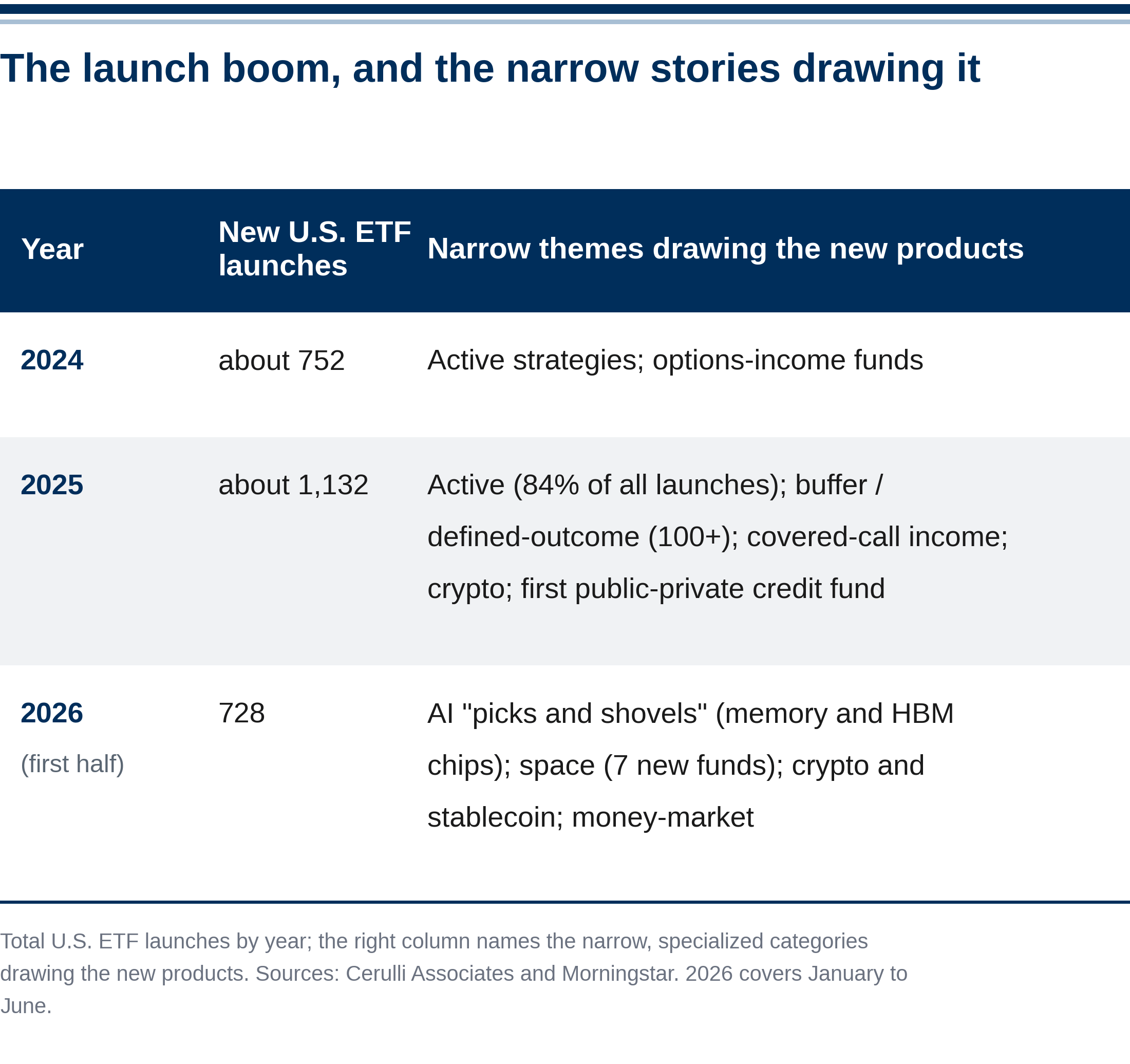
Notice what the current crop has in common. The dominant narrow themes of the past two years, artificial intelligence sliced ever finer into memory chips and infrastructure, space, crypto and stablecoins, are the stories that have run hardest and drawn the most coverage. That is not a coincidence. It is the mechanism the research describes, operating in plain view. Products get built where the attention already is.
None of this is a prediction that these particular themes will fall, and you should be suspicious of anyone who tells you otherwise, including me. Expensive stories can stay expensive for years, and calling the turn is exactly the prediction game principle-based investing avoids. The point is narrower and more useful. These are the categories where the conditions the study warns about, rich valuations and attention-driven buying, are most concentrated today. That is a reason for care, not a signal to short anything.
The historical scoreboard
The more sobering exhibit is backward-looking, and it needs no forecast at all. Look at what happened to investors in the last few theme waves in the years after the money arrived.
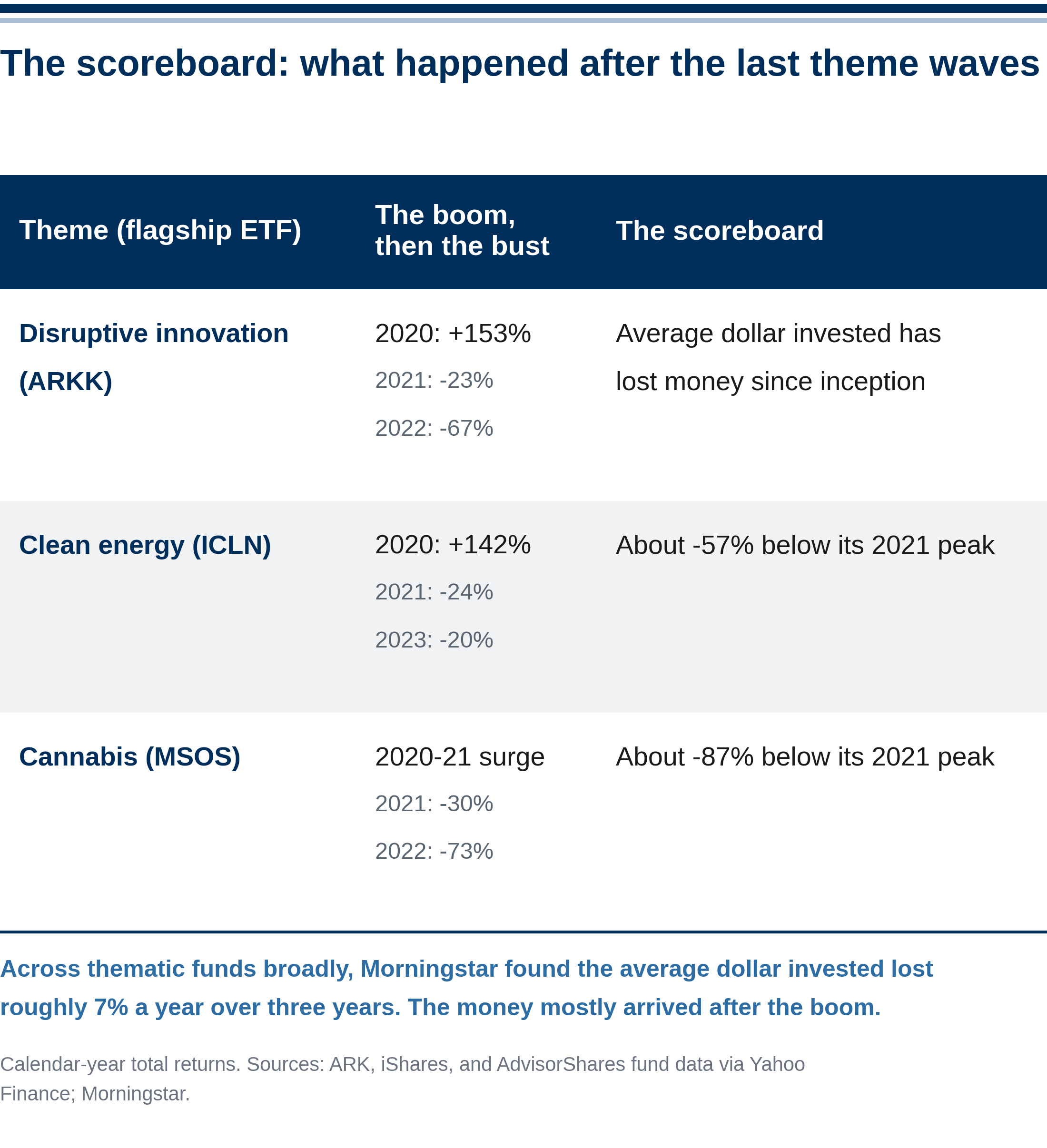
Read across each row and the same shape appears. A spectacular boom year that made the theme famous and pulled in the assets, followed by a long, punishing descent. The clean-energy funds returned well over 100 percent in 2020, then fell for years. Cannabis went from the hottest story in the market to down more than 85 percent from its peak. Disruptive innovation had one of the great single years in fund history in 2020, and then gave most of it back.
The cruelest detail is in the last column. Because most of the money arrived after the boom, the average investor’s experience was far worse than the fund’s published returns suggest. A fund can show a positive return since inception while the typical dollar invested in it has lost money, simply because the big returns came when few people owned it and the big losses came when everyone did. Morningstar, which tracks this gap every year, found that the average dollar invested in thematic funds lost roughly 7 percent annually over a recent three-year stretch. The funds did badly. The investors in them did worse, because they bought the story after it was already expensive.
Investing is not about maximizing your return; it is about earning a competitive return, one sufficient to reach your long-term goals, while managing risk. Thematic ETFs invert that idea. They dangle the possibility of a maximized return on a single story and quietly hand you concentrated risk, high costs, and an entry price set at the moment of peak enthusiasm. The evidence, gathered over the full history of these products and visible in every theme wave since, says the trade has not paid. Own the whole market cheaply, keep your costs down, and let the themes come and go without you.
From Insights to Action
Knowing which investments to avoid is only half the job. The harder and more valuable work is building the portfolio that puts the principles to work: the specific, low-cost funds for broad diversification, the right high-quality bonds for ballast, and a sensible cash reserve. That is what our fund research library and model portfolios are built for, an in-depth look at the funds that meet our high standards, plus model portfolios that combine them for broad, low-cost diversification. Explore the research library at Investmentinsights.com.
More Investment Insights:
InvestmentInsights.com - Link to our website. 90+ in-depth mutual fund & ETF research reports on funds that meet our high standards, model portfolios with quarterly updates, the Investment Academy and more.
This Large-Cap Fund has Outperformed the S&P 500 for 10 years - at an Index-Fund Price - One of our favorite funds
Model Portfolios: Q2 2026 Quarterly Commentary - Featuring our latest models and performance for Q2
Alternative Investments: Are Private Markets Worth It? - The final part of our five-part series.
Monthly Commentary | August 3, 2026 - Market and economic update
New reader? Start with our pinned Start Here guide for how to get the most out of Investment Insights.
Alan F. Skrainka, CFA, is the founder of Alan Skrainka, LLC and the author of Principle-Based Investing. Over a career of more than 40 years in the investment industry, he spent 28 years at Edward Jones, where he served as Chief Market Strategist and a General Partner. His work is published at InvestmentInsights.com and on Substack at Investment Insights by Alan Skrainka.
InvestmentInsights.com Insights | Education | Solutions
Free: Market commentary, investor education and principle-based essays every week. New articles are free to read for their first two months. The perspective that makes everything else useful, at no cost.
Paid ($8/month or $80/year): Everything in Free, plus subscriber-only posts, our featured fund and ETF write-ups, the “how to use this in a real portfolio” sections, and the complete Investment Insights Archive, with every article we have published, organized by topic.
All-Access Founding Member ($179/year): Everything in Paid, plus full access to InvestmentInsights.com: 90+ in-depth research reports on funds and ETFs that meet our high standards, model portfolios with quarterly updates, the Investment Academy and more.
Start free. You can upgrade to Paid or All-Access anytime.
Important Disclosures
Copyright © Alan Skrainka, LLC 2026. All rights reserved. InvestmentInsights.com is owned and operated by Alan Skrainka, LLC. The information on this website and in all published articles is for general informational and educational purposes only and should not be considered personalized investment guidance, a recommendation, or a solicitation to buy or sell any security. Neither Alan Skrainka, LLC nor InvestmentInsights.com are registered investment advisors, broker-dealers, or financial planners. The content published on this site is taken from sources that are believed to be reliable, and efforts are made to ensure accuracy; completeness and timeliness are not guaranteed. All model portfolios, mutual fund reviews, and ETF commentaries express the views of the author at the time of publication. Such materials are illustrative, are not tailored to your personal situation, and should not be relied on for investment decisions. Investing involves risk, including the potential loss of principal. Past performance is not indicative of future results. Securities and ETF values fluctuate, and investors may receive more or less than their original investment upon redemption. ETF shares are traded at market prices and may trade at a premium or discount to net asset value. Brokerage commissions and other costs may apply. Diversification does not guarantee profit or protect against loss. The author may hold personal positions in some of the investments mentioned herein; however, there are no financial arrangements or compensation agreements with any mutual fund company, ETF, or security discussed on this website. All content is the intellectual property of Alan Skrainka, LLC and may not be reproduced, transmitted, distributed, broadcast, or modified without prior written consent. This content is intended for U.S. residents only. InvestmentInsights.com does not provide personalized investment guidance or establish a fiduciary relationship. Readers are strongly encouraged to consult a licensed investment professional before making financial or investment decisions.
Thank you J.Anthony!
Thanks for penning this well-argued point. Always thought this was the key reason they underperform: “The mechanism: sold at the peak of a story” – glad to see others, notably fellow charterholders, agree.